SuperQode
SUPERQODE
Superior Quality-Oriented Agentic Software Development.
Orchestrating coding agents as Super Quality Engineers using the SuperQE methodology. Let agents break the code. Prove the fix. Ship with confidence.
Orchestrate, Validate, and Deploy Agentic Software with Unshakable Confidence.
What is SuperQode and SuperQE?
SuperQE is the quality paradigm and automation CLI: Super Quality Engineering for Agentic AI. It uses QE coding agents to break and validate code written by coding agents. SuperQE can spawn a team of QE agents with different testing personas in a multi-agent setup to stress your code from many angles.
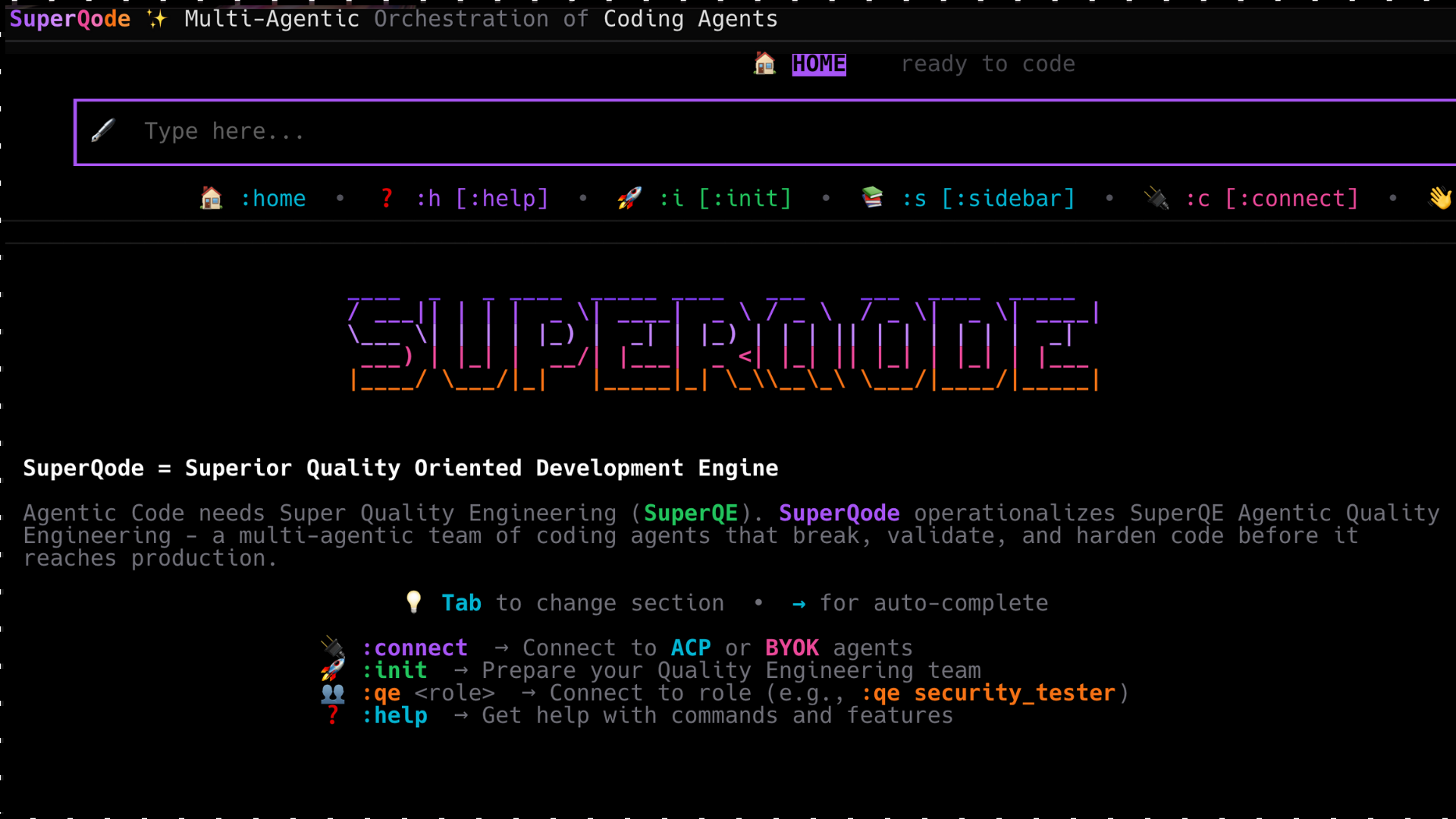
SuperQode is the agentic coding harness designed to drive the SuperQE process. It delivers a Superior and Quality Optimized Developer Experience as a TUI for interactive development, debugging, and exploratory QE. SuperQode can also be used as a general development harness beyond QE.
Note (Enterprise): Enterprise adds powerful automation, deep evaluation testing, and enterprise integrations (OpenClaw first; more bot integrations coming).
Why SuperQode Exists
AI coding agents have changed how software is written, but quality engineering still assumes human authorship, deterministic behavior, and slow change. That mismatch creates a new risk surface:
- PR review catches syntax but not emergent behavior
- Static analysis misses runtime failure modes
- Human QA cannot keep pace with agent velocity
- "Looks correct" is no longer evidence of safety
SuperQode closes this gap by letting agents fight agents in safe sandboxes and turning the results into evidence-based decisions.
What Is SuperQE?
SuperQE (Super Quality Engineering) is a quality methodology for agentic software:
- AI agents act as Quality Engineers
- Multiple agent personas attack code from different angles
- Failures are discovered through exploration and adversarial testing
- Fixes are verified with evidence, not assumed correct
- Humans remain the final decision-makers
SuperQE is not test generation. It is adversarial validation with reproducible evidence.
What Is SuperQode?
SuperQode is the execution harness for SuperQE:
- A CLI (
superqe) for automation and CI/CD runs - A TUI (
superqode) for interactive, exploratory QE - A sandboxed workspace model that snapshots, tests, and reverts safely
- A role-based agent system for coverage across security, API, regression, full-stack, and chaos testing
One install ships both entrypoints. You can use them together or independently.
How SuperQode Works (Lifecycle)
- SNAPSHOT -> preserve original code
- SANDBOX -> agents attack, test, and experiment freely
- REPORT -> produce Quality Reports with evidence
- REVERT -> restore the original repo state
- ARTIFACTS -> keep QRs, traces, and patches separately
Agents are free to break things - your repo is always restored.
Design Principles
- Quality-first, not code-first
- Agents break, humans decide
- Safety by default
- Evidence over opinions
- Self-hosted and privacy-first
SuperQE runs cleanly in CI/CD pipelines, while SuperQode drives SuperQE for interactive workflows. You can also use each independently.
What you get out of a run:
- A QR with prioritized findings, reproduction steps, and collected evidence
- Optional (Enterprise): verified patch suggestions and generated tests
Safety model: by default, SuperQode does not modify your repo. All exploratory changes happen in a sandbox and are reverted; humans decide what to apply.
# After install, in your repo:
superqe init

# Start the developer TUI (recommended for interactive workflows)
superqode

# Or run automated QE CLI
superqe run . --mode quick
superqe init creates a comprehensive role catalog in superqode.yaml. Disable or delete roles you don’t need.
Quick Install
Verify installation:
Deployment Options
SuperQode OSS is self-hosted. You are responsible for model/API infra costs. For Enterprise capabilities (including integrations like OpenClaw, with more coming), see enterprise/index.md.
How It Works
SuperQode uses an ephemeral workspace model that enables fearless, exhaustive testing while ensuring your original code is always preserved:
┌─────────────────────────────────────────────────────────────┐
│                    QE SESSION LIFECYCLE                      │
├─────────────────────────────────────────────────────────────┤
│                                                              │
│  1. SNAPSHOT         Original code preserved                 │
│        ↓                                                     │
│  2. QE SANDBOX       Agents freely modify, inject tests,    │
│        │             run experiments, break things           │
│        ↓                                                     │
│  3. REPORT           Document what was done, what was found │
│        ↓                                                     │
│  4. REVERT           All changes removed, original restored │
│        ↓                                                     │
│  5. ARTIFACTS        QRs, patches, tests preserved          │
│                      (in .superqode/qe-artifacts/)          │
│                                                              │
└─────────────────────────────────────────────────────────────┘
Within the sandbox, agents may:
- Perform destructive and adversarial testing
- Simulate malicious or edge behaviors
- Stress CPU, memory, I/O, and concurrency
- Run linters, fuzzers, profilers, and analyzers
- Explore undefined and rare failure paths
This enables fearless, exhaustive testing - agents explore freely while your original code remains untouched.
Who is This For?
-
Startups
CI/CD maturity but need quality assurance without QE headcount. Super Quality Engineers replace or augment human QA teams.
Fast-moving teams scaling quality engineering with AI agents
-
SMEs
Limited or no dedicated QE team. SuperQE methodology provides add-on-grade quality engineering without add-on costs.
Growing companies needing quality validation without hiring QE teams
-
Teams Using AI Coding Agents
Need quality validation for AI-generated code. Orchestration of coding agents ensures agent-written code meets production standards.
Teams using GitHub Copilot, Cursor, or other AI coding tools
-
Engineering Teams
Want to scale QA with code velocity. SuperQE transforms reactive QA into proactive, agentic quality engineering.
Engineering teams adopting Agentic Quality Engineering methodology
Key Features
-
Sandbox-First Testing
All testing happens in isolated ephemeral workspaces. Your code is never modified without explicit consent. Changes are always reverted.
-
Multi-Agent Orchestration
Multiple AI agents with different roles and perspectives attack your code simultaneously, reducing blind spots and increasing coverage.
-
Quality Reports (QRs)
Research-grade forensic reports with evidence, reproduction steps, root cause analysis, and verified fix suggestions.
-
Three Connection Modes
Connect via BYOK (100+ providers), ACP (coding agents), or Local models. Use your preferred infrastructure.
-
Configurable Roles
Define custom QE roles with specific personas, job descriptions, and testing focus areas tailored to your needs.
-
CI/CD Integration
JSONL streaming, JUnit XML output, and GitHub Actions support for seamless integration into your pipeline.
Quick Start
Follow the on-screen instructions to explore, debug, and run QE sessions interactively.
Three Execution Modes
SuperQode supports three distinct modes for connecting to AI models:
| Mode | Description | Use Case |
|---|---|---|
| ACP | Agent Client Protocol - Full coding agent integration | OpenCode, Claude Code (advanced capabilities) |
| BYOK | Bring Your Own Key - Direct LLM API calls via LiteLLM | Cloud providers (Google Gemini, Anthropic, OpenAI, etc.) |
| Local | Local/self-hosted models | Ollama, vLLM, LM Studio (privacy-first) |
QE Execution Modes
| Mode | Timeout | Depth | Test Generation | Use Case |
|---|---|---|---|---|
| Quick Scan | 60s | Shallow | No | Pre-commit, PR checks |
| Deep QE | 30min | Full | Enterprise | Pre-release, audits |
# Quick scan for fast feedback
superqe run . --mode quick

# Deep QE for thorough analysis (Enterprise)
superqe run . --mode deep --generate --allow-suggestions
Code Modification Policy
Default Behavior: Read-Only
SuperQode NEVER modifies user-submitted production code by default. All fixes are suggested, never auto-applied.
When allow_suggestions is enabled, SuperQode follows a strict workflow:
1. DETECT BUG      → Agent finds issue in submitted code
2. FIX IN SANDBOX  → Agent modifies code to fix bug
3. VERIFY FIX      → Run tests, validate fix works
4. PROVE BETTER    → Demonstrate improvement with evidence
5. REPORT OUTCOME  → Document findings and observations
6. ADD TO QR      → Record in Quality Report
7. REVERT CHANGES  → Restore original submitted code
8. USER DECIDES    → Accept/reject suggested patches
Why SuperQode?
The Problem
-
AI Coding Has Outpaced QA - Code is now written faster than humans can meaningfully test. Traditional QA processes cannot keep up with the velocity, scale, and complexity of agent-generated software.
-
Existing Tools Stop at Code Review - Most incumbent tools focus on PR comments, static analysis, or surface-level reviews. They do not actively break code, perform destructive testing, validate fixes in sandbox environments, or prove production readiness with evidence.
-
QE Is Treated as Reporting, Not Problem Solving - Traditional QA workflows optimize for tickets and findings, not for validated fixes, benchmarks, or proof of improvement.
-
Incumbent QA + "Agentic AI" Falls Short - Many existing testing platforms attempt to "add agents" to legacy QA systems. This approach fails structurally due to systems not being agent-native by design, mismatch between deterministic QA and probabilistic agents, and single-agent or same-model bias.
The Solution: SuperQE
SuperQode introduces SuperQE through orchestration of coding agents - a new quality paradigm where:
- Coding agents are orchestrated as Super Quality Engineers aggressively attacking code in sandbox
- Multiple agents with different perspectives challenge each other
- Orchestrated agents can inject test code, run experiments, and break things
- All changes are tracked and demonstrated in reports
- Original code is always preserved
- Humans review outcomes and approve/reject fixes
Let agents fight agents. Humans decide.
Key Differentiators
- Quality-first, not code-first - Focus on breaking, not building
- QRs instead of bug reports - Research-grade findings with evidence
- Sandbox freedom with safety - Agents explore freely; original preserved
- Multi-agent, cross-model - Diverse perspectives, fewer blind spots
- User-defined harness and roles - No opinionated workflows
- Human-in-the-loop by design - Findings and suggestions, not auto-apply
- Self-hosted, privacy-first - Your code stays in your environment
- Prove-then-revert model - Demonstrate fixes work, then restore original
Supported Providers
| Agent | Capabilities | Status |
|---|---|---|
| OpenCode | File editing, shell, MCP, 75+ providers | Supported |
| Amp | File editing, shell, MCP, multi-turn | Supported |
| Claude Code | Native Claude integration | Supported |
| Codex | OpenAI code generation | Supported |
| Gemini CLI | Google's reference ACP implementation | Supported |
| Provider | Models | Free Tier |
|---|---|---|
| Google AI | Gemini 3 Pro, Gemini 3, Gemini 2.5 Flash | Yes |
| Anthropic | Claude Opus 4.5, Sonnet 4.5, Haiku 4.5 | No |
| OpenAI | GPT-5.4, GPT-4o, o1 | No |
| Deepseek | Deepseek V3, Deepseek R1 | Yes |
| Groq | Llama 3.3, Mixtral | Yes |
| Together AI | 200+ open models | Limited |
| Provider | Description |
|---|---|
| Ollama | Easy local model deployment |
| LM Studio | GUI-based local models |
| vLLM | High-performance inference |
| llama.cpp | C++ inference engine |
Documentation Structure
Getting Started Installation, quick start, and first QE session
Concepts Core concepts: modes, workspace, roles, QRs
CLI Reference Complete command documentation
Configuration YAML reference and settings
QE Features Quality engineering capabilities
Providers BYOK, ACP, Local, and OpenResponses
Integration CI/CD, Docker, GitHub Actions
Advanced MCP, custom roles, harness validation
API Reference JSONL events and Python SDK
Community & Support
Vision
As software becomes increasingly agent-written, only agentic quality engineering can keep it safe.
SuperQode orchestrates coding agents as Super Quality Engineers and operationalizes SuperQE (Agentic Quality Engineering). Let agents break the code. Prove the fix. Ship with confidence. Validate readiness before humans approve release.